
REQUEST FOR APPLICATIONS (RFA) for Early Grade Education Activity (EGEA), also known as (ASAS) Project
Issuance Date: December 22, 2025
Closing Date: January 21, 2026
Closing Time: 16:00 EST
Subject: Request for Applications (RFA) Number 1 ASAS
Reference: Issued under International Research and Exchange Board (IREX) project and DOS Cooperative Agreement No. 72027823CA00002
This Request for Applications outlines the information required from the applicant for the development and submission of a proposal for consideration. The potential applicant is expected to review, understand, and conform with specifications contained in this RFA. Failure to do so will be at the applicant’s own risk.
All reasonable, allocable, and allowable expenses, both direct and indirect, which are related to the subaward program and are in accordance with applicable cost standards (usually 2 CFR 200 Subpart E Cost Principles), may be charged under the subaward.
For non-US organizations the Department of State Standard Terms and Conditions and 2 CFR 200 Subpart A through E apply.
This RFA is being issued and consists of this cover letter, Schedule A, and Annexes.
Issuance of this RFA does not constitute an award commitment on the part of ASAS/IREX nor does it commit ASAS/IREX to pay for costs incurred in the preparation and submission of an application. The application is submitted at the risk of the applicant. All preparation and submission costs are at the applicant's expense.
Thank you for your interest in ASAS/IREX activities.
Sincerely,
Cameron Mirza
Chief of Party
ASAS
SCHEDULE A
SECTION I: FUNDING OPPORTUNITY DESCRIPTION
The Early Grade Education Activity (EGEA), also known as the ASAS Project, is a five-year initiative funded by the U.S. Department of State (DOS) and implemented by IREX. ASAS is dedicated to transforming early grade education in Jordan by strengthening teacher preparation, professional development, curriculum design, and evidence-based policy implementation. Targeting kindergarten through grade three (KG–G3), ASAS seeks to build a highly skilled teaching workforce capable of improving literacy, numeracy, and socio-emotional learning outcomes.
A core component of ASAS is its commitment to equipping faculty members with the latest, research-driven teaching strategies and ensuring quality assurance in the delivery of revamped academic programs. This includes comprehensive training for university faculty to adopt innovative pedagogical approaches, integrate active learning methodologies, and effectively mentor pre-service teachers.
To achieve these goals, ASAS will facilitate collaboration between U.S. universities and Jordanian higher education institutions to revise and modernize Jordanian BA programs in Early Grade and Early Childhood Education. This process will encompass curriculum development (including practicum design), research integration, quality standards, accreditation processes, and professional development for faculty. Engagement activities may include exchange visits, joint workshops, and regular technical meetings to share best practices, foster peer-to-peer learning, and adapt proven international models to the Jordanian context.
Interested U.S.-accredited higher education institutions (HEIs) are encouraged to propose additional ideas and initiatives that align with this scope, particularly those that advance faculty capacity-building and ensure sustainable quality improvements in teacher education.
Scope of Work
In support of EGEA/ ASAS Result 1, “Improved Quality of Early Grade Pre-Service Education Programs,” IREX invites U.S.-accredited HEIs to apply for a subaward under its current program aimed at strengthening early grade pre-service teacher education (PSTE) in Jordan. The selected institution will collaborate with Jordanian universities to support the implementation of key activities that enhance the quality and effectiveness of PSTE programs.
This partnership will play a pivotal role in supporting Jordanian counterparts to strengthen curricula, teaching practices, and quality systems that contribute to building a resilient, highly qualified teaching workforce prepared to advance early grade learning outcomes across Jordan.
The scope of work includes:
- Leading professional development for faculty members at ASAS partner Jordanian HEIs.
- Supporting quality assurance and accreditation efforts, including alignment with standards such as those of the U.S.-based Council for the Accreditation of Educator Preparation (CAEP) and the National Association for the Education of Young Children (NAEYC).
Proposed Tasks
Faculty Professional Development:
The selected U.S. HEI will design and implement a hybrid faculty development program to strengthen pre-service educator preparation in Jordan. This initiative will result in a sustainable transformation of PSTE in Jordan by elevating instructional quality through modern, learner-centered, and technology-integrated pedagogies, and building institutional excellence by empowering faculty leaders to drive continuous professional development. This program will be delivered in close collaboration with Jordanian universities and will focus on enhancing instructional quality, innovation, and institutional capacity and excellence.
Key responsibilities include:
- Program Design: Develop comprehensive training materials, at least three online modules and one face-to-face module, for a hybrid faculty development program that combines face-to-face sessions, self-paced online modules, and applied research projects. The content will focus on:
- Learner-centered pedagogy
- Assessment-oriented learning
- Integration of digital and AI-powered tools
- Transformational leadership in education
- Program Delivery: Train and coach a cohort of 16 faculty members, from four Jordanian universities currently partnered with ASAS, selected to serve as Master Trainers. These individuals will lead ongoing professional development efforts within their institutions, fostering sustainability and local ownership to serve as Master Trainers. Formally designated by their respective institutions, these individuals will lead future professional development efforts, ensuring sustainability and local ownership. Once certified in the relevant topics, they will begin cascading the training to a broader group in the next phase—not in parallel with the current scope.
- Impact Measurement: Assess the effectiveness of the training through a combination of pre- and post-training surveys, classroom observation rubrics, feedback loops, and institutional performance indicators co-developed with the ASAS MEL team.
- Recognition: Provide participants with a fellowship or certification upon successful completion of the program to acknowledge their professional growth and commitment.
- Exchange Visits: In order to support classroom observation and knowledge exchange, a two-way faculty exchange program via a study tour will be facilitated between U.S. and Jordanian institutions. Sixteen (16) Jordanian faculty members (4 representatives each from the 4 institutions) will travel to the U.S. for 2 weeks in September 2026 to participate in selected components of the professional development (PD) program in person. The U.S. HEI should plan to support the facilitation of the visit. IREX will be responsible for the expected study tour expenses and leading the visa process. In return, U.S. faculty will visit Jordan to observe classroom instruction and assess how effectively the PD learnings are being implemented in practice. The U.S. faculty visit in Jordan should be planned for either April/ May or November/ December 2026 and should estimate 2 weeks of travel for at least 4 U.S. faculty to meet simultaneously with the 4 Jordanian HEIs. These visits will also serve as opportunities to collect data on current teaching methodologies in Jordan, enabling the refinement and contextualization of PD content to better align with local needs.
Support CAEP Accreditation and Quality Enhancement
Key responsibilities include:
- Technical Assistance for CAEP Accreditation: The U.S.-accredited HEI will provide targeted technical support to partner universities in preparing for CAEP accreditation. This includes advisory sessions, technical review of processes and evidence, and guidance on aligning teacher preparation programs with accreditation standards.
- Advise on Quality Assurance Best Practices: The U.S.-accredited HEI will share and advise on international best practices for enhancing program quality. Support will focus on curriculum delivery, practicum planning, student support, and continuous improvement processes to strengthen institutional quality systems.
Deliverables
Please find below an illustrative timeline of possible activities:
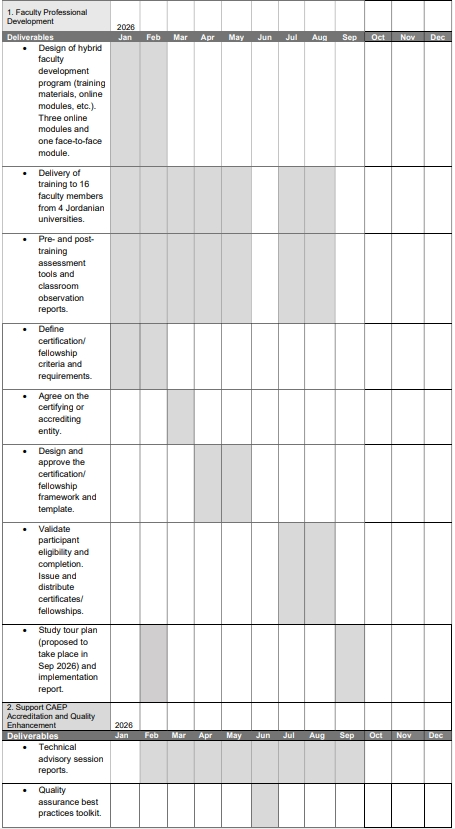
Governance, Data, and Intellectual Property (IP)
Data Management Plan (DMP)
Within 30 days of signing the award, the U.S.-accredited HEI will work with IREX to establish clear data management practices. These will include identifying the types of data to be collected, outlining secure storage methods, defining access protocols, and setting procedures for data retention, disposal, and the sharing of de-identified data. All identifiable data must be securely stored in repositories mutually agreed upon by both parties.
Intellectual Property (IP)
Unless otherwise specified, all Intellectual Property (IP) will remain the property of the U.S.-accredited HEI. However, the HEI will grant IREX and participating Jordanian universities a non-exclusive license to use, adapt, translate, and distribute project deliverables for non-commercial educational purposes. This license includes the right to sublicense to public institutions. All materials will be provided in editable formats to facilitate adaptation and use.
Accessibility and Localization
All project deliverables will be produced in English and translated into Arabic by the US-accredited HEI for submission to ASAS. Materials will adhere to Universal Design for Learning (UDL) and accessibility standards and will incorporate approved branding and visibility guidelines.
United States Government (USG) Regulations
Under this award, Department of State Standard Terms and Conditions and 2 CFR 200 Unified Administrative Requirements Subpart A through E apply.
SECTION II: AWARD INFORMATION
Subject to the availability of funds, IREX expects to award one (1) subaward, ranging from 300,000 to 650,000 USD. The total amount available is 650,000 USD. The expected duration of IREX’s support or the period of performance is January or February 2026 to December 2026. ASAS/IREX reserves the right to fund any or none of the applications submitted.
SECTION III: ELIGIBILITY INFORMATION
Eligibility of Applicants:
- Eligible applicants are higher education or training institutions accredited by a recognized U.S. accrediting body. Institutions should demonstrate strong academic standing, and if the selected institution is a university, consideration will be given to its placement in reputable U.S. and international rankings as well as its track record in education and teacher preparation.
- The faculty team who will work on this project should reflect a varied profile, including specializations in literacy, numeracy, social-emotional learning (SEL), and a mix of academic scholars and practitioner-experts capable of delivering targeted support across these domains. It is preferred, but not required, that faculty teams consist of members that are bilingual in English and Arabic. Applicants should share the bios of the proposed faculty team who will be working on the project.
- The selected HEI must commit to close collaboration with Jordanian partner universities, ensuring contextual adaptation of international best practices. Engagement could include workshops, exchange visits/study tours, technical advisory sessions, and joint research initiatives, both face-to-face and virtual.
- Applicants must uphold the highest standards of academic integrity, professional ethics, and quality assurance. All deliverables must align with Jordanian national priorities and international standards, including those set by CAEP and the NAEYC.
Additionally, the applicant /application must meet the following requirements:
- Be officially registered and working in compliance with all applicable U.S. civil and fiscal regulations, including, but not limited to pertinent local laws and status.
- Be officially registered as a legal entity and working in compliance with all applicable local laws. An applicant can show proof of effort to secure registration if not yet registered.
- Meet the project’s objectives and principles.
- Contain expected outcomes and results consistent with, and linked to, the project’s objectives.
- Applicant is not a debarred organization.
- Receive a U.S. government Unique Entity ID (UEI) from SAM.gov.
SECTION IV: APPLICATION AND SUBMISSION INFORMATION
- Any questions concerning this RFA should be submitted via email no later than 10 days prior to the closing date shown above to procurement.asas@irex.org. Applicants should retain for their records one copy of all enclosures which accompany their application.
- The application must be received by ASAS/IREX’s email indicated above no later than the closing date listed on the front page of this RFA. Pre-award costs are not allowable and will not be reimbursed.
- The complete application packet must be submitted in the required format with the required attachments.
- Application:
- UEI number
- Organizational background (2-page limit)
- Program description (4-page limit)
- Beneficiaries, outcomes, and expected impact
- Monitoring and evaluation
- Budget and budget narrative
- Project workplan
Restrictions
- Subaward funds provided under the terms of this RFA shall not be used to procure goods or services from suppliers that may be identified on the USG consolidated list of debarred, suspended, or ineligible contractors at http://www.sam.gov/.
- Any purchases or activities deemed unnecessary to successfully complete the activity, including any subawardee headquarters’ expenses that are not directly linked to the implementation of the proposed project.
- Previous obligations and/or bad debts.
- Fines and/or penalties.
- Other costs unallowable as referenced in 2 CFR 200 Subpart E “Cost Principles.”
Late Applications
Late applications are marked as “late” and are ineligible for review or award; however, IREX reserves the right to accept and include late applications in the review and award process when it is considered within the best interest of IREX to do so and if applications that were received on time have not been opened and reviewed. Applications that are submitted late or incomplete run the risk of not being considered for review.
SECTION V: APPLICATION REVIEW INFORMATION:
The application will be evaluated according to the evaluation criteria set out below. To the extent necessary (if an award is not made based on initial applications), negotiations may be conducted with each applicant whose application, after discussion and negotiation, has a reasonable chance of being selected for an award.
Evaluation Criteria
- Technical Merit (70 points)
- Relevance to program goals:
- Proposed illustrative agenda for exchange visit/study tour.
- Approach to technical assistance on CAEP accreditation.
- Plan for advising on best practices.
- Proven track record in designing and delivering evidence-based PD programs for higher education faculty.
- Ability to integrate technology-enhanced learning and digital pedagogy into PD.
- Established Quality Assurance (QA) framework aligned with international standards. Please share a link or attachment of an example.
- Experience in program accreditation processes and continuous improvement cycles.
- Capability to support data-driven decision-making for QA.
- Experience in implementing Learning Management Systems (LMS) and digital QA dashboards. Please share a link or attachment of an example.
- Capability to support digitization of academic processes.
- Sustainability of project results:
- Plan to ensure capacity strengthening in Jordan for Jordanian counterparts to continue the work after the end of the subaward.
- Ability to design long-term partnership models that ensure sustainability.
- Anticipated impact on beneficiaries.
- Experience in regional capacity building and knowledge transfer.
- Academic Programs Offering:
- The faculty of the HEI’s Education Department must offer accredited programs specifically focused on early grade education and classroom teacher preparation, demonstrating a commitment to excellence in teacher education.
- University Culture:
- The HEI should demonstrate a commitment to sustainability across various aspects of their operations, including environmental stewardship, social responsibility, and economic resilience through integrating sustainability initiatives into campus practices.
- Accreditations: CAEP or NAEYC accredited – Highly Preferable
- Relevance to program goals:
- Past Performance and Organizational Capacity (15 points)
- Past performance in similar projects.
- Relevant staff skills to the proposed project:
- Faculty members within the HEI’s Education Department should possess relevant qualifications, expertise, and experience in early grade education. They should demonstrate the ability to provide technical assistance, feedback, and guidance to support the enhancement of teacher education programs. Please share CVs of key personnel proposed to lead training content and interactive activities in Arabic. Technical advisors with direct coaching responsibilities should have more than 7 years' experience in early grade education and proficiency in both Arabic and English languages.
- U.S. or International Ranking and School of Education College Ranking:
- A reputable top-ranked university on QS ranking or any equivalent ranking system.
- Experience in the geographical region (Jordan/Middle East).
- Written accounting and procurement procedures.
- Capacity to adhere to U.S. Department of State financial guidelines.
- Feasibility and Cost Effectiveness (15 points)
- Are costs reasonable, allowable, and allocable.
- Is the proposal cost effective.
SECTION VI: AWARD AND ADMINISTRATION INFORMATION
The recommendation or selection of an application in accordance with established procedures does not guarantee an award. All applicants must demonstrate that they possess, or have the ability to obtain, the necessary management competence to practice mutually agreed upon methods of accountability for funds and other assets provided.
A successful applicant can expect to receive an Award Letter signed by the program. The award letter will be addressed to the HEI’s point of contact as stated in the application. Applicants that were not successful can expect a letter explaining the reason for their unsuccessful application.
Following the Award Letter, final negotiations will take place before signing a subaward agreement.
Reporting Procedures
A description of reporting requirements will be included in the Subaward Agreement. The types of reporting required, along with the schedule of reporting, will depend on the subaward agreement and project duration. Reporting forms will be provided to subaward recipients. Types of reporting will include the following:
- Program report to be submitted during project implementation according to a schedule described in the Subaward Agreement. This report will include a description of progress made during the period, problems in project implementation, actions taken to overcome them, and activities planned for the next period.
- Final program report will describe how the project objectives and goals were reached, results of the project, and problems and solutions during implementation.
- Financial reports will be submitted according to a schedule described in the Subaward Agreement. The types of financial reports, as well as the schedule of reporting, will depend on the type of subaward, length of the project, and amount of funding. In addition, the subawardee is required to submit a detailed Final Financial Report.
Issuance of the final installment of subaward funds is contingent upon ASAS/IREX receipt and acceptance of Final Financial and Final Program Reports.
SECTION VII - OTHER INFORMATION
Issuance of this RFA does not constitute an award or commitment on the part of IREX, nor does it commit ASAS/IREX to pay for costs incurred in the preparation and submission of an application.
IREX reserves the right to fund any or none of the applications submitted. Further, IREX reserves the right to make no awards as a result of this RFA.
ANNEX 1: Standard Terms and Conditions
- U.S. Department of State Standard Terms and Conditions (https://www.state.gov/wp-content/uploads/2025/03/Standard-Terms-and-Conditions-for-Federal-Awards-10.1.24-15.pdf).
- 2 CFR 200 Uniformed Administrative Requirements Subpart A-through E (eCFR :: 2 CFR Part 200 Subpart E -- Cost Principles).
- 2 CFR 600 The Uniform Administrative Requirements, Cost Principles, and Audit Requirements for Federal Awards (https://www.ecfr.gov/current/title-2/subtitle-B/chapter-VI/part-600).
- 2 CFR 601 Nonprocurement Debarment and Suspension (https://www.ecfr.gov/current/title-2/subtitle-B/chapter-VI/part-601).
Public Notice
REQUEST FOR APPLICATIONS (RFA) for ASAS
Issuance Date: December 15, 2025
Closing Date: January 14, 2025
I. SUMMARY:
The Early Grade Education Activity (EGEA), also known as (ASAS) project is a 5-year program funded by the United States Department of State (DOS) and implemented by IREX. ASAS works to strengthen early grade education by improving teacher preparation, professional development, curriculum, and evidence-based policies. Focusing on kindergarten through grade three (KG–G3), ASAS aims to build a well-prepared teaching workforce capable of improving literacy, numeracy, and socio-emotional learning outcomes.
To achieve this, ASAS will engage U.S. universities to collaborate with Jordanian higher education institutions (HEIs) on revising the BA programs in Early Grade and Early Childhood Education through curriculum development including practicum, research, quality and accreditation, and faculty professional development. Engagements could include exchange visits, joint workshops, and regular technical meetings to share best practices, foster peer-to-peer learning, adapt proven international models to the Jordanian context. Interested U.S.-accredited HEIs are also encouraged to propose more ideas and initiatives that align with the proposed scope.
II. PURPOSE:
This RFA is seeking applicants to propose effective approaches to a collaboration with Jordanian universities to support the implementation of key activities that enhance the quality and effectiveness of PSTE programs.
This partnership will play a pivotal role in supporting Jordanian counterparts to strengthen curricula, teaching practices, and quality systems that contribute to building a resilient, highly qualified teaching workforce prepared to advance early grade learning outcomes across Jordan.
III. LOCATION OF ACTIVITIES:
The geographic focus under consideration includes the following countries for regional activities: Jordan.
IV. PROGRAM OBJECTIVES:
- Leading professional development for faculty members in partnership with Jordanian HEIs.
- Supporting quality assurance and accreditation efforts, including alignment with standards such as those of the Council for the Accreditation of Educator Preparation (CAEP) and the National Association for the Education of Young Children (NAEYC).
V. APPLICANTS ELIGIBILITY CRITERIA:
- Eligible applicants are Higher Education or Training Institutions accredited by a recognized U.S. accrediting body. Institutions should demonstrate strong academic standing, and if the selected institution is a university, consideration will be given to its placement in reputable US and international rankings as well as its track record in education and teacher preparation.
- The faculty team should reflect a varied profile, including specializations in literacy, numeracy, social-emotional learning (SEL), and a mix of academic scholars and practitioner-experts capable of delivering targeted support across these domains preferably bilingual in English and Arabic. (Bios of the working team to be shared.)
- The selected HEI must commit to close collaboration with Jordanian partner universities, ensuring contextual adaptation of international best practices. Engagement could include workshops, study tours, technical advisory sessions, and joint research initiatives both face-to-face and virtual.
- Applicants must uphold the highest standards of academic integrity, professional ethics, and quality assurance. All deliverables must align with Jordanian national priorities and international standards, including those set by CAEP and NAEYC.
VI. AWARD INFORMATION
Subject to the availability of funds, IREX expects to award 1 subaward, ranging from 300,000 to 650,000 USD. The total amount available is 650,000 USD. The expected duration of IREX’s support or the period of performance is February 2026 to December 2026. ASAS/IREX reserves the right to fund any or none of the applications submitted. Further, IREX reserves the right to make no awards under this RFA.
VII. CONTACT INFORMATION:
Please contact the following to receive the Request for Application and the application packet: procurement.asas@irex.org