Early Grade Education Activity (ASAS)

  • U.S. flag
  • IREX logo

Early Grade Education Activity (ASAS)

2023-2028 • $49 million • Partners: IREX, Vanderbilt University (VU), Florida State University (FSU), School-to-School International, Queen Rania Teacher Academy (QRTA), Development Gateway (DG)

Jordan’s Ministry of Education (MoE) provides public education to over 1.6 million students and a growing transnational population. Jordan has a disproportionately large youth population and quality education is critical to national growth and stability, regional security, and long-term prosperity. A strong U.S.-Jordan partnership in education advances shared interests: a stable, economically productive Jordan is a reliable partner in a critical region. 

Jordan has made great strides in advancing its education system. Yet, according to international benchmarks the quality of early grade learning in Jordan is under capacity to meet comprehensive development standards for nationwide economic stability, citizen mobility and human development. It is essential for Jordan’s stability that all children receive a quality education to gain foundational reading and mathematics skills necessary for future success.

Investing in foundational learning when children first enter school is more cost effective than investing in remedial, or “catch up” education later on.

ASAS visual saying Every Child Can be Remarkable

Overview

The Early Grade Education Activity (ASAS) strengthens Jordan's early grade education system through four integrated streams: pre-service educator preparation reform, in-service professional development at scale, AI and digital transformation, and evidence-based policy and quality assurance. ASAS partners with the Ministry of Education, four Jordanian universities, the Accreditation and Quality Assurance Commission (AQAC), and the Ministry of Higher Education. Two U.S. universities provide direct academic partnership. The program operates across all of Jordan's governorates.

ASAS aims to strengthen the early grade education system by improving the quality of pre-service educator training and in-service educator professional development (TPD), enhancing early grade curriculum, and teaching and learning materials (TLM), and supporting evidence-based systems and policies that promote system-wide alignment, maximize return on investment (ROI), and improve foundational numeracy and literacy (FLN) skills across the kingdom of Jordan. To achieve the intended results, the IREX-led consortium will apply a regenerated, evidence-based approach that (1) coherently merges system-wide education policy reform to support quality early grade education, and (2) seeks practical ways to leverage AI to improve the education system.

“Investing in early grade education is a national priority and a fundamental strategic pillar for ensuring sustained improvement in the quality of education outcomes over the long term. These early years form the foundation for essential literacy, numeracy, and critical thinking skills, shaping students’ future learning pathways and overall success. Strengthening early grade education is therefore a key entry point to achieving equitable, high-quality education and preparing students to contribute meaningfully to Jordan’s economic and social development.” H.E. Dr. Azmi Mahafzah, Minister of Education and Minister of Higher Education and Scientific Research, Hashemite Kingdom of Jordan

Anticipated Results

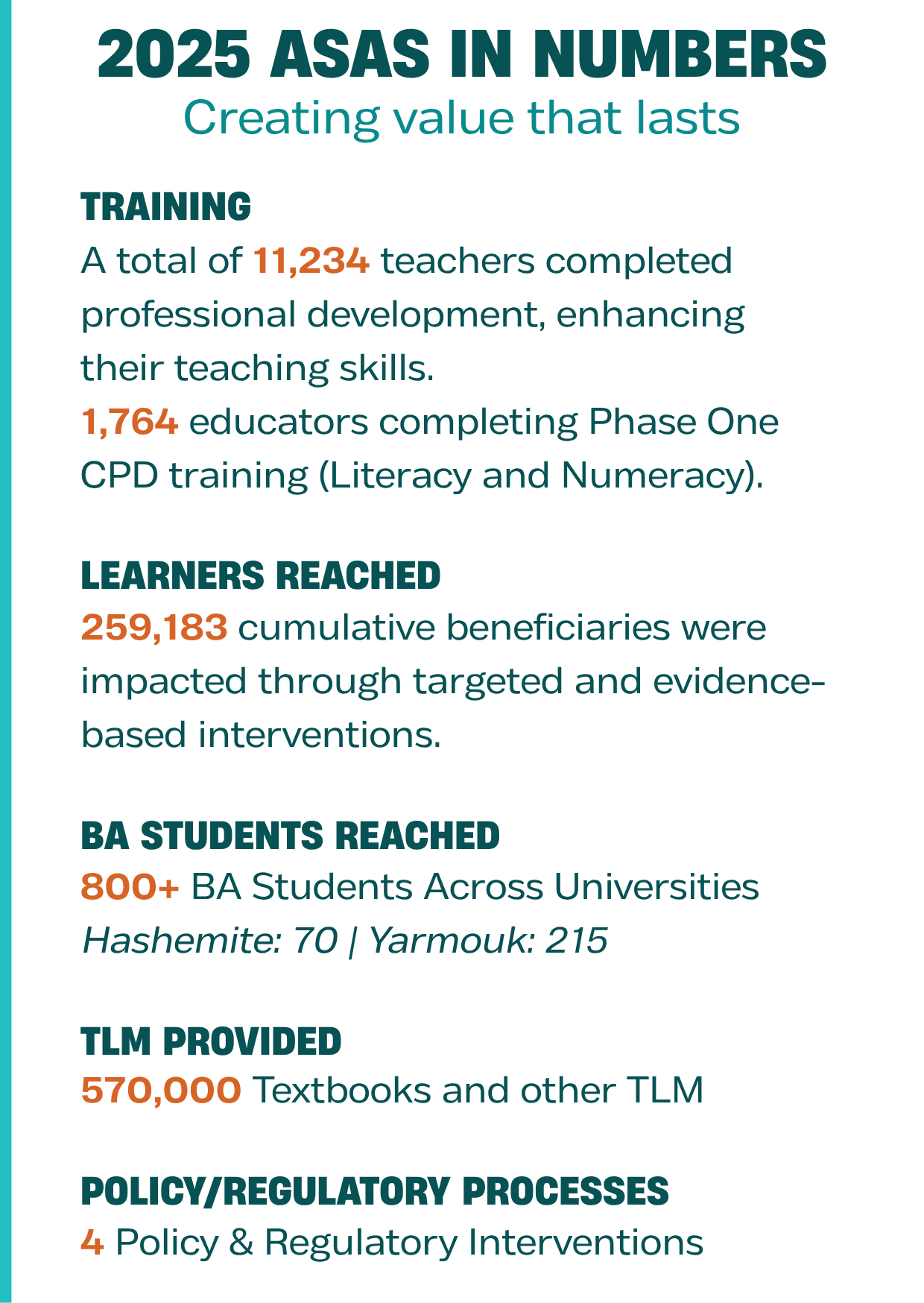
  • 23,500+ educators equipped with enhanced foundational literacy and numeracy instruction skills
  • 1 million+ KG-Grade 3 students reached through strengthened educator preparation
  • National AI governance framework adopted by the Ministry of Education
  • Jordan's MoE independently operating U.S.-origin digital assessment systems at national scale
  • Evidence-based policies institutionalized across practicum reform, educator licensing, and quality assurance
  • AI skills framework for educators adopted by the Ministry of Education 
  • 130 faculty equipped with AI literacy across four partner universities

AI & Digital Transformation

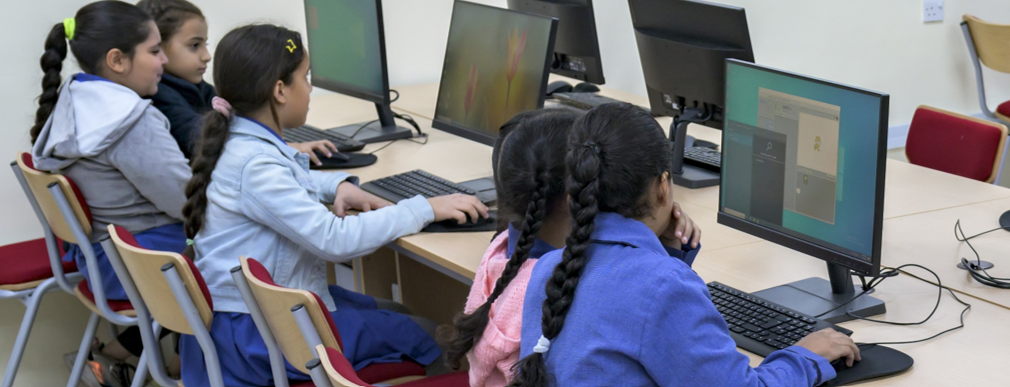
group of young students using computers in computer lab
 
ASAS leads Jordan's national AI agenda in early grade education across three tracks:
National Education AI Readiness Assessment

ASAS leads on a national education AI diagnostic that provides a baseline and recommendations for the successful adoption of AI in the school system that will allow both educators and students to enhance the learning experience.

AI Capacity Building 

ASAS builds AI skills through the development of a Generative AI micro-credential for pre-service educators, co-developed with Vanderbilt University. This accredited micro-credential will be awarded for pre service educators across 4 public universities to support the use of AI in a safe and ethical manner in a classroom.

AI Tool Testing 

ASAS works with the higher education sector to develop and test AI tools in coordination with university faculty and students to establish user cases before scaling.

"The AI Readiness Assessment should serve as an input into national planning efforts, not as a standalone initiative." A synthesized summary of the key findings, inputs, priorities, and recommendations emerging from ASAS consultations with the Ministry of Digital Economy and Entrepreneurship (MoDEE).

Impact Report

Every Child Can Be Remarkable!

Learn more about exceptional gains being made in foundational literacy, numeracy, and educator effectiveness across the early grade education system in Jordan. Access the report.

IREX and its partners are sharing new evidence from the ASAS Activity, an initiative in Jordan focused on improving early childhood and early grade education that is funded by the U.S. Government. By strengthening teacher preparation, classroom practice, data use, and policy, ASAS is helping expand learning opportunities for children across the country.

The results are remarkable. In 2025, math proficiency rose from 13.7% to 18.6% in Grade 2 and from 29.3% to 36% in Grade 3. Reading comprehension also improved, increasing from 38.3% to 62.8% in Grade 2 and from 58.7% to 79.4% in Grade 3. At a time when many education systems are still recovering from COVID-19 learning loss, these gains highlight the value of early investment and a stronger, more responsive education system.

Partners

Implementing Consortium

The Implementation of Early Grade Education (ASAS) is led by International Research & Exchanges Board (IREX), who acts as the collaborative facilitator of the consortium, alongside five other implementing partners:
IREX Logo

Offering a strong track record in building local capacity for high-quality pre-service and teacher in-service professional development (PD) in Jordan and across the MENA region. IREX has established relationships with the Government of Jordan (GOJ) and has successfully navigated complexities to achieve sustainable reforms. IREX also bolsters private sector and local leadership with international expertise, sharing research, experience, and innovative ideas from education projects worldwide.

 

STS logo

School-to-School International (STS): With over 20 years of experience building local actors’ capacity across all stages of assessment, STS strengthens the use of data to improve early grade policy and practice.

 

Development Gateway logo

Development Gateway (DG): Possesses distinct expertise in enhancing user-centered digital solutions to support local actors in improving systems' interoperability. By syncing and analyzing data from various sources, early grade system actors will be better equipped to learn and adapt interventions, craft responsive policies, and allocate resources to priorities.
QRTA Logo

Queen Rania Teacher Academy (QRTA): Plays a crucial role in improving the quality of early-grade pre-service education programs. QRTA is responsible for strengthening quality assurance systems and processes, developing a pre-service teacher education curriculum framework aligned with early-grade national teacher competencies, and mapping the existing curriculum. Additionally, QRTA leads professional development for teacher educators and collaborates with U.S. higher education institution peers to design or upgrade program courses.

Vanderbilt University Logo

Vanderbilt University co-develops ASAS's reformed pre-service curriculum, contributing to 60+ revised courses across four Jordanian universities. Vanderbilt leads the Generative AI micro-credential co-development and ongoing Communities of Practice on AI in Educational Sciences, embedding U.S. academic innovation and AI frameworks directly into Jordan's educator preparation system.

Florida State University Logo

FSU contributes to faculty development and integration of U.S.-developed AI and education frameworks into Jordan's educator preparation curricula.


Counterparts and Clients

  • Ministry of Education
  • The Ministry of Higher Education and Scientific Research
  • Accreditation and Quality Assurance Commission (AQAC)
  • The National Center for Human Resources Development
  • National Center for Curriculum Development
  • Jordanian Universities:
    • University of Jordan
    • Yarmouk University 
    • Hashemite University
    • Mutah University
"The collaboration with ASAS will contribute to building a generation of better prepared and more capable teachers, and that is the most meaningful investment we can make in the future of Jordan's children." AQAC

"Through our partnership with ASAS, the University of Jordan has strengthened its teacher preparation programs and aligned its curricula with international standards, equipping future educators to make a lasting impact on Jordan's children." UJ

Respectively: H.E. Prof. Thafer Assaraira, President, Accreditation and Quality Assurance Commission (AQAC) and Prof. Dr. Nahed Omesh, Vice President for Humanities, University of Jordan

People

Contact