
A leader’s path: How one veteran is redefining leadership after service
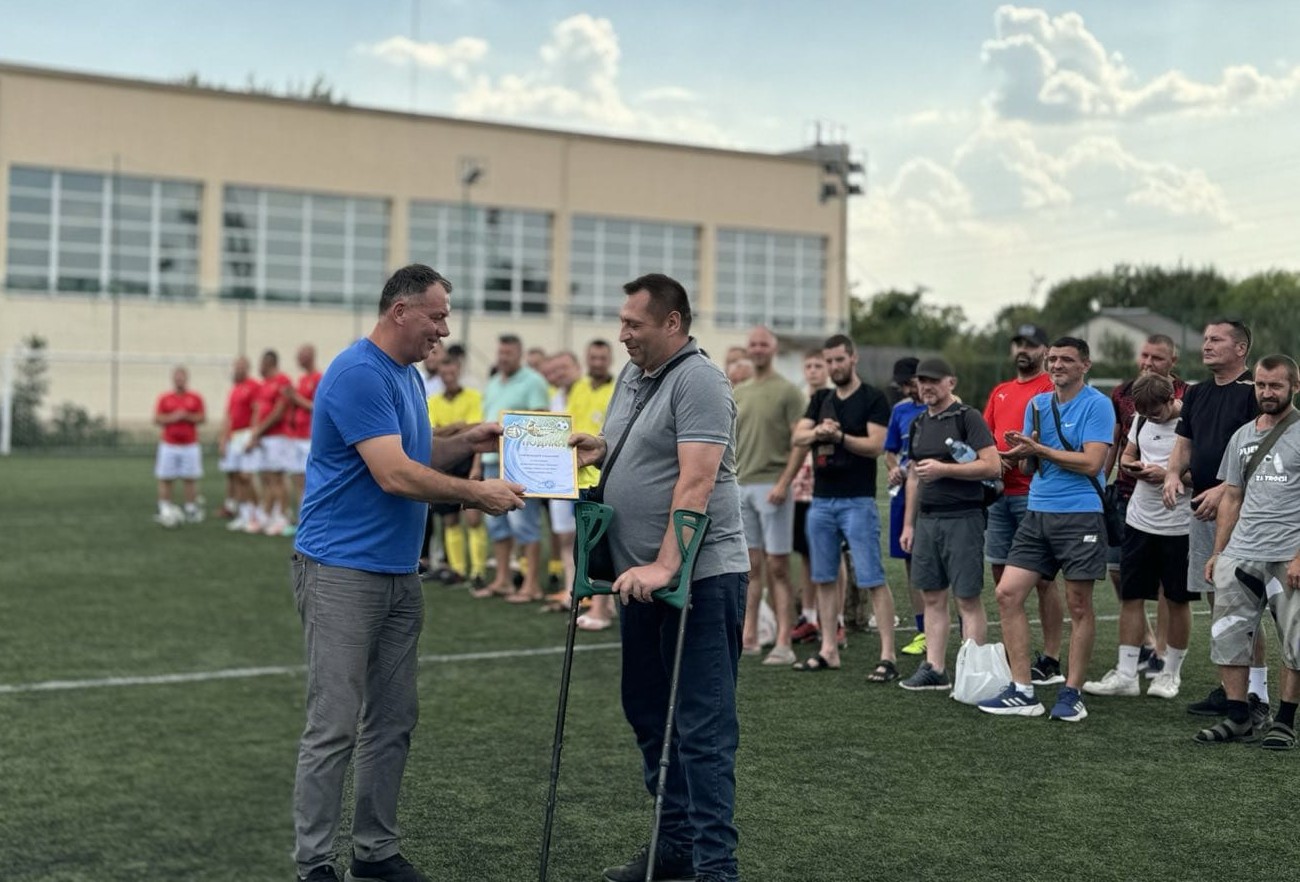
For some, leadership is defined by titles. For Oleksandr Sushanin, it’s about the ability to lead others, even when every step is a challenge.
Oleksandr went to the front lines in 2022. Two years later, a severe leg injury ended his service and transitioned him to civilian life. Today, he uses a prosthetic leg, but his perseverance and desire to lead has only grown stronger.
From service to community leadership
After being discharged, Oleksandr created a private support space for veterans. In 2025, when the Movement for Supporting Transcarpathian Military – Uzhhorod invited him to the Leadership School for veterans, he immediately accepted.
At the Leadership School, 13 veteran leaders from rural communities in Transcarpathia took part in an intensive two-day training. Participants engaged in expert presentations and motivational sessions with veteran entrepreneurs and local influencers. The focus went beyond personal development and included economic resilience, local leadership, and long-term integration.
Engaging in collective action
What began as a short training evolved into something more lasting. Inspired by their training on economic resilience, the veterans formed a business cluster for mutual support and cooperation. Their plans include launching a craft winery and a fish farm. While land access remains a significant obstacle, the men are determined. Their goal is not only to generate income, but also to create sustainable employment for veterans.
Independence through opportunity
Though the School provided knowledge in business and law, Oleksandr noted that social capital is his most valuable asset. Through the program, he met the head of a driving school that was offering courses using specially-equipped vehicles that he could drive.
"I had never driven a car before. But you can’t go far on a prosthetic, and I’m not used to sitting still. I earned my Class B license at the driving school, and the training was completely free for me. Now I can move around the city freely, and it gives me an incredible sense of independence," Oleksandr shares.
Advocating for dignity
Oleksandr’s leadership soon extended beyond his peer network. After seeing how hard it was for fellow veterans to find employment due to business prejudices, he decided to act. During a city-wide conversation, Oleksandr and his colleagues spoke up to the mayor.
"Businesses are often afraid to hire veterans. They use labels like 'amputees' or 'shell-shocked.' But we are professionals. There are plenty of jobs where you can set up an inclusive workspace—monitoring security consoles, for example. My friends and I went to meet with the Mayor of Uzhhorod. We explained: if there are job problems now, while there aren't that many of us in the city yet, what will happen when everyone returns?"
Oleksandr also says,"I’m genuinely glad we are building a constructive dialogue. We aren't just asking for things—we are making our case and changing our community for the better."
Oleksandr’s story demonstrates how leadership development, peer networks, and opportunities can empower veterans to reintegrate and shape more beneficial local systems for communities.
The project was made possible by the Veteran Reintegration Program, implemented by IREX with support from the U.S. Department of State.